


PureCube Cu-NTA MagBeads
Order number: 31501-Cu
Description
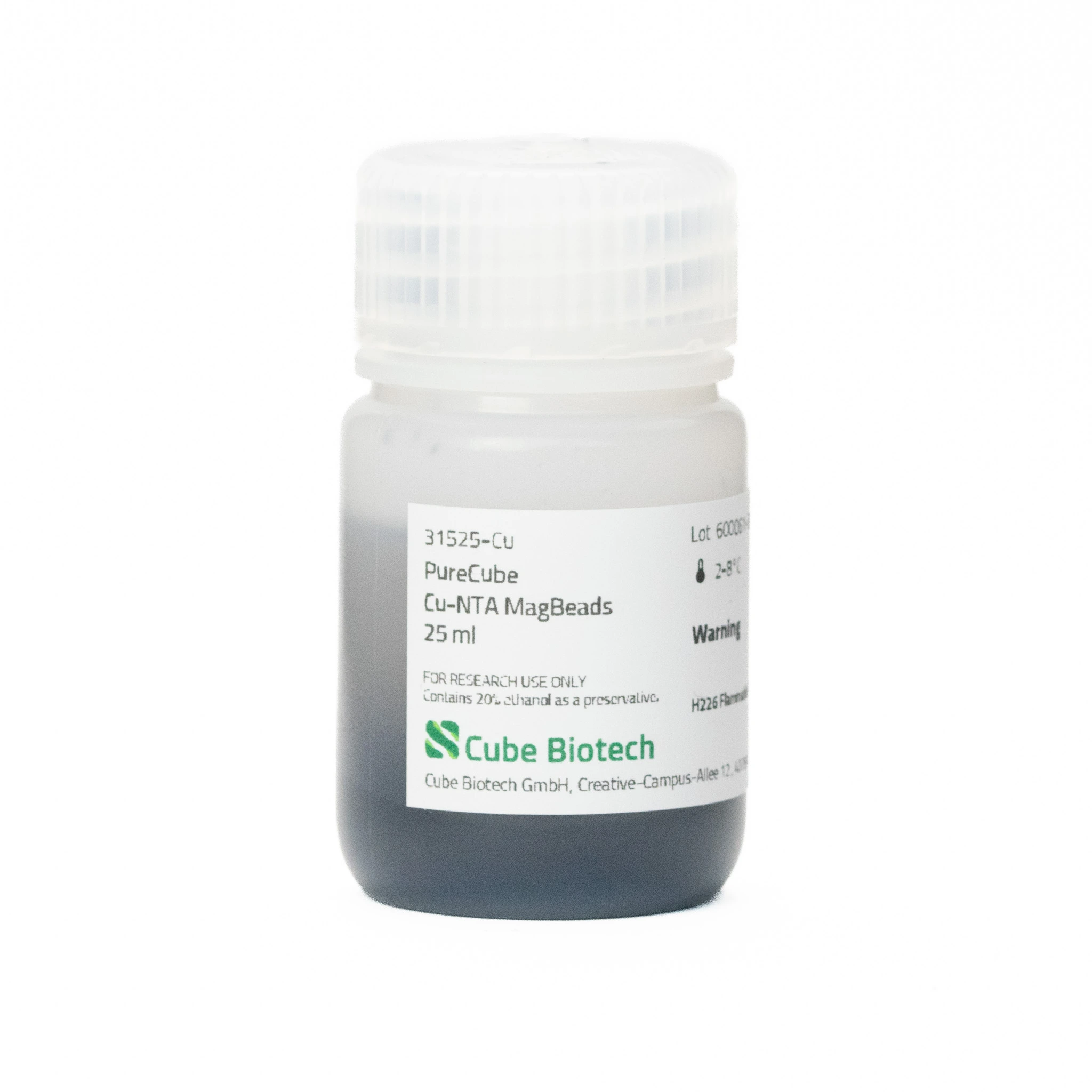
PureCube Cu-NTA magnetic beads / MagBeads were developed by Cube Biotech for His-tag protein purification. Our year-long experience in manufacturing agarose resin lead to the high yield of 50 mg protein per ml resin, which is leading in the market compared to other Cu-NTA suppliers.
Cu-NTA products by Cube Biotech are also available as agarose resin beads for FPLC and batch spin. For your convenience Cube Biotech also offers its own MagBead separator for use with our magnetic beads.
Cu-NTA products by Cube Biotech are also available as agarose resin beads for FPLC and batch spin. For your convenience Cube Biotech also offers its own MagBead separator for use with our magnetic beads.
Datasheets
| Feature | |
|---|---|
| Usage | Specific binding and purification of 6x His-tagged proteins |
| Specificity | Affinity to His-tagged proteins |
| Binding capacity | 50 mg protein/ml pure beads. Binding capacity was determined with a 27 kDa 6xHis-tagged GFP protein. Please note that the binding capacity is protein dependent. |
| Bead Ligand | Cu-NTA |
| Bead size | 20-40 µm (30 µm average) |
| Matrix | Spherical magnetic agarose beads, cross-linked, 6% agarose |
| Filling quantity | 25% (v/v) suspension (20 µl suspension corresponds to 5 µl magnetic beads) |
| Storage Buffer | 20 mM sodium acetate with 20% ethanol, pH 6.6 |
| Metal ion capacity | >12 µeqv Zn2+ /ml |
| Compatible reagents | 1 mM DTT, 1 mM EDTA, 100% methanol, 100% ethanol, 8 M urea, 6 M guanidinium hydrochloride, 30% (v/v) acetonitrile |
| Stability | 2 years after shipping |
| Short Term Storage | In neutral buffer (e.g. 50 mM phosphate, pH 7.0); 2-8°C |
| Long Term Storage | In neutral buffer containing 20% ethanol |
| Shipping | Room temperature |
Citations
| Purified Protein | Year | Author |
|---|---|---|
| Enriching Histidine Peptides | 2021 | Miyagi M., Tanaka K., Watanabe S., Kondo J., Kishimoto T. |
| Look in publication | 2023 | Vanzetti L. Germanis M., Potrich C. |
Lab Results
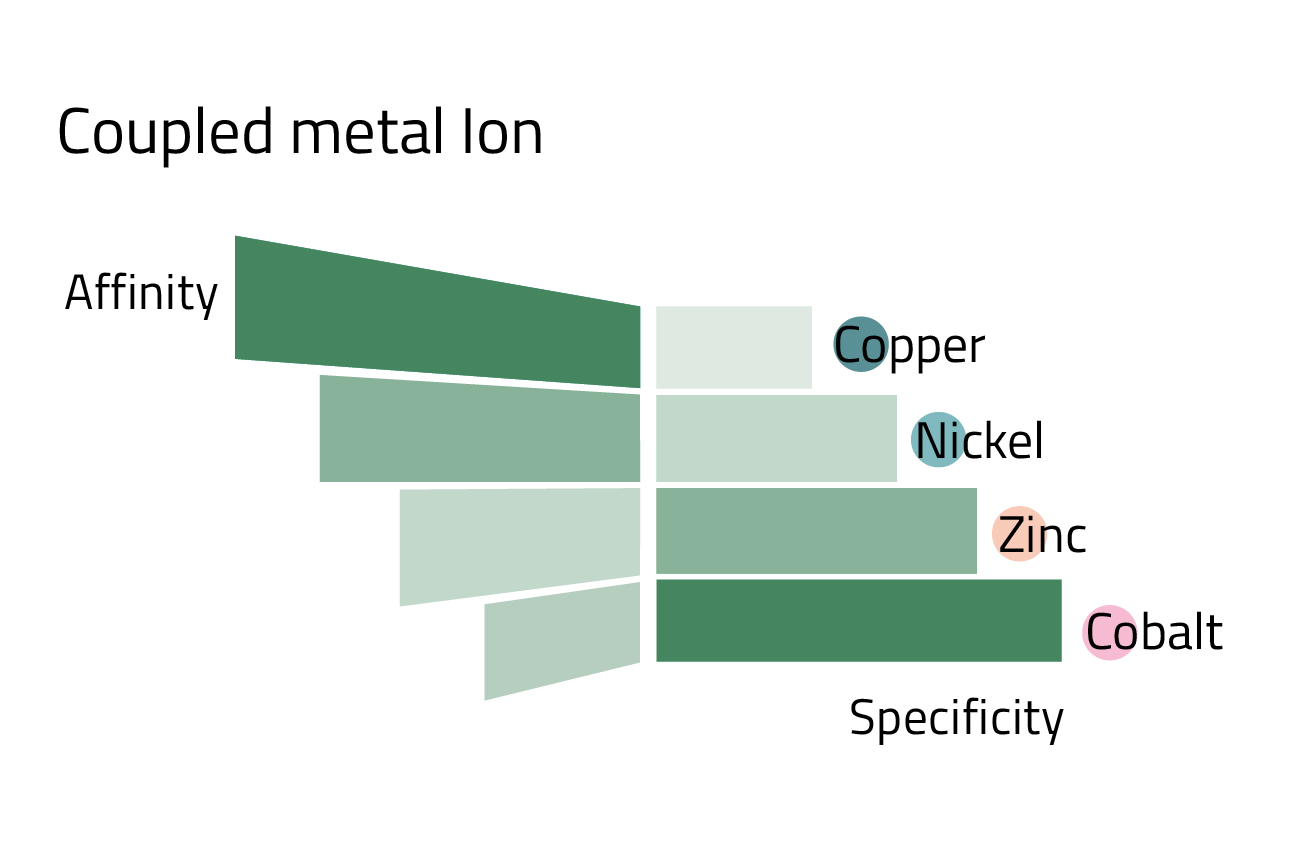
Different metal ions confer different binding affinity and specificity
Loading different metal ions to a resin results in differing affinity and specificity for a His-tagged protein. Generally, copper exhibits the highest protein yield of commonly used IMAC metal ions, leading to relatively lower purity. In searching for the optimal resin to purify a protein, it is recommended to explore different chelating ligands (IDA or NTA) and different metal ions.
Loading different metal ions to a resin results in differing affinity and specificity for a His-tagged protein. Generally, copper exhibits the highest protein yield of commonly used IMAC metal ions, leading to relatively lower purity. In searching for the optimal resin to purify a protein, it is recommended to explore different chelating ligands (IDA or NTA) and different metal ions.
Video
Video Guide - How to use MagBeads
FAQ
Can I get the datasheet for the Cu-NTA MagBeads?
What are the reasons for non-specific binding?
Some protein can bind to Cu-NTA even without having a His-tag. But to a lesser extent. Washing with NaOH after elution of your protein of interest removes unspecific bound proteins from your resin.
I want to use a high concentration of EDTA and DTT. Is it possible to use Cu-NTA from Cube Biotech?
No, it is not recommended because nickel-ions are reduced with DTT or dissolved with EDTA. If you want to use high concentrations of EDTA and DTT you should use our Indigo-Ni MagBeads.
Can Cu-NTA beads be stripped?
Yes, they can. However, we recommend using our pre-stripped NTA or IDA beads, to begin with.
After using DTT my resin changed color. How to regenerate it?
The DTT has probably destroyed your beads. Cu-NTA beads only have a very limited DTT tolerance. However, you can regenerate them to regain their functionality. Please read our detailed protocol for more information regarding this. It is linked above.
However, we would recommend using Ni-INDIGO products instead. They work with the same buffers and protocols as the Cu-NTA products but have a DTT tolerance of 20 mM.
However, we would recommend using Ni-INDIGO products instead. They work with the same buffers and protocols as the Cu-NTA products but have a DTT tolerance of 20 mM.