


Toll-like receptor 5
Organism: Homo sapiens (Human) | Gene names: TLR5, TIL3

Entry: O60602
Mass: 97.834 Da
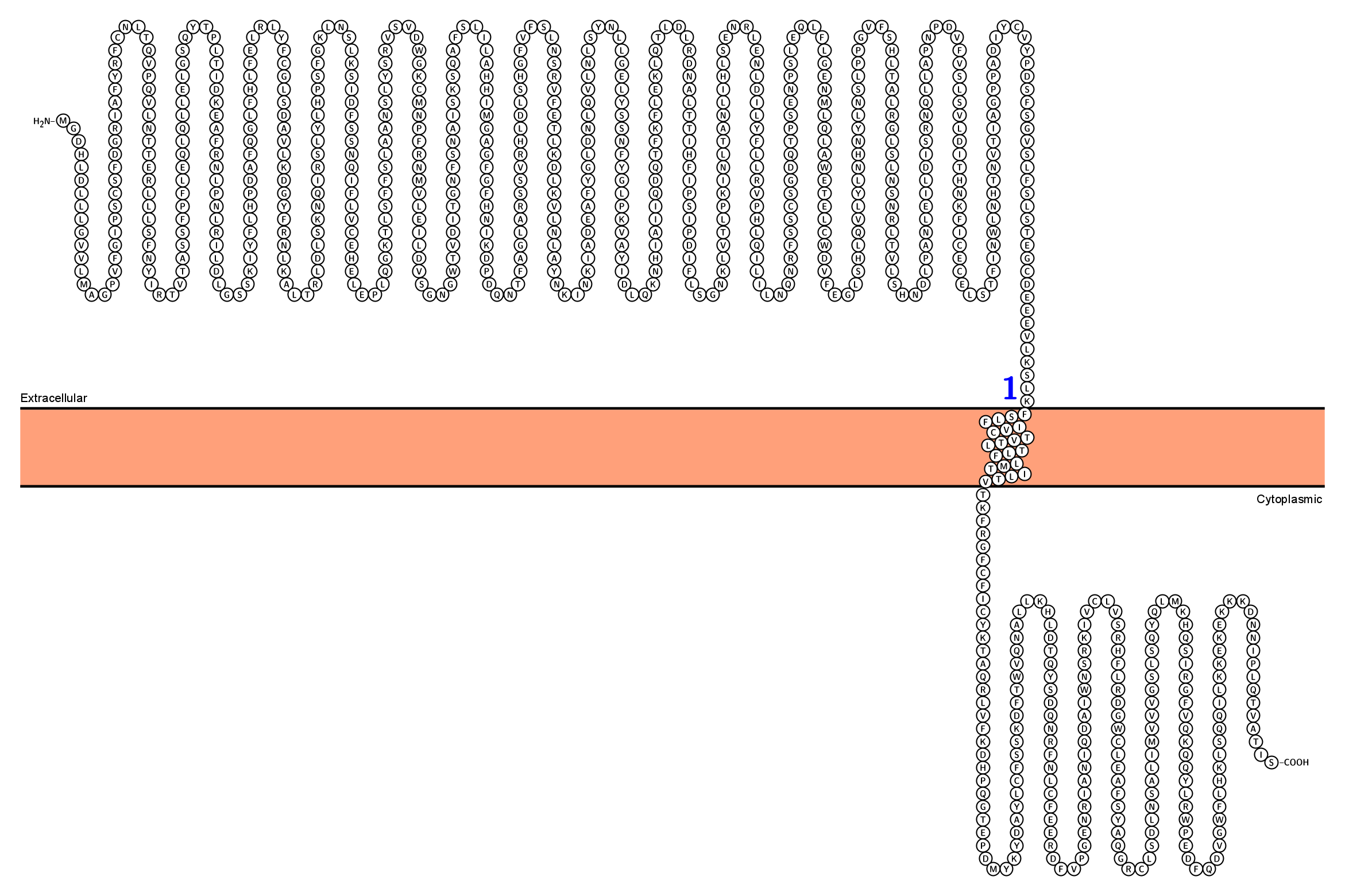
Transmembrane: 1
Subcellular location: Cell membrane {ECO:0000269|PubMed:24778236}, Single-pass type I membrane protein {ECO:0000255}.
Cofactor: -
Extinction coefficient: 0.985
Isoelectric Point: 6.21
PubMed ID: 9596645, 18810425, 19179655, 19924287, 16710414, 15489334, 9435236, 15340161, 11489966, 11323673, 16027372, 17157808, 17442957, 18490781, 20855887, 23447684, 24778236, 29934223, 22173220, 14623910
Family: Toll-like receptor family
Function:
Pattern recognition receptor (PRR) located on the cell surface that participates in the activation of innate immunity and inflammatory response (PubMed:11323673, PubMed:18490781). Recognizes small molecular motifs named pathogen-associated molecular pattern (PAMPs) expressed by pathogens and microbe-associated molecular patterns (MAMPs) usually expressed by resident microbiota (PubMed:29934223). Upon ligand binding such as bacterial flagellins, recruits intracellular adapter proteins MYD88 and TRIF leading to NF-kappa-B activation, cytokine secretion and induction of the inflammatory response (PubMed:20855887, PubMed:11489966). Plays thereby an important role in the relationship between the intestinal epithelium and enteric microbes and contributes to the gut microbiota composition throughout life (By similarity). {ECO:0000250|UniProtKB:Q9JLF7, ECO:0000269|PubMed:11323673, ECO:0000269|PubMed:11489966, ECO:0000269|PubMed:18490781, ECO:0000269|PubMed:20855887, ECO:0000269|PubMed:29934223}.
Data from experiment(s):
Involvement in disease:
Systemic lupus erythematosus 1 (SLEB1) [MIM:601744]: A chronic, relapsing, inflammatory, and often febrile multisystemic disorder of connective tissue, characterized principally by involvement of the skin, joints, kidneys and serosal membranes. It is of unknown etiology, but is thought to represent a failure of the regulatory mechanisms of the autoimmune system. The disease is marked by a wide range of system dysfunctions, an elevated erythrocyte sedimentation rate, and the formation of LE cells in the blood or bone marrow. Note=Disease susceptibility is associated with variants affecting the gene represented in this entry.
Binding site:
-
Tissue specificity:
Highly expressed on the basolateral surface of intestinal epithelia (PubMed:11489966). Expressed also in other cells such as lung epithelial cells (PubMed:11489966, PubMed:18490781). {ECO:0000269|PubMed:11489966, ECO:0000269|PubMed:18490781}.
3D (X-ray crystallography):
Model (1); Electron microscopy (1)
Pharmaceutical use:
-
AS sequence:
MGDHLDLLLGVVLMAGPVFGIPSCSFDGRIAFYRFCNLTQVPQVLNTTERLLLSFNYIRTVTASSFPFLEQLQLLELGSQYTPLTIDKEAFRNLPNLRILDLGSSKIYFLHPDAFQGLFHLFELRLYFCGLSDAVLKDGYFRNLKALTRLDLSKNQIRSLYLHPSFGKLNSLKSIDFSSNQIFLVCEHELEPLQGKTLSFFSLAANSLYSRVSVDWGKCMNPFRNMVLEILDVSGNGWTVDITGNFSNAISKSQAFSLILAHHIMGAGFGFHNIKDPDQNTFAGLARSSVRHLDLSHGFVFSLNSRVFETLKDLKVLNLAYNKINKIADEAFYGLDNLQVLNLSYNLLGELYSSNFYGLPKVAYIDLQKNHIAIIQDQTFKFLEKLQTLDLRDNALTTIHFIPSIPDIFLSGNKLVTLPKINLTANLIHLSENRLENLDILYFLLRVPHLQILILNQNRFSSCSGDQTPSENPSLEQLFLGENMLQLAWETELCWDVFEGLSHLQVLYLNHNYLNSLPPGVFSHLTALRGLSLNSNRLTVLSHNDLPANLEILDISRNQLLAPNPDVFVSLSVLDITHNKFICECELSTFINWLNHTNVTIAGPPADIYCVYPDSFSGVSLFSLSTEGCDEEEVLKSLKFSLFIVCTVTLTLFLMTILTVTKFRGFCFICYKTAQRLVFKDHPQGTEPDMYKYDAYLCFSSKDFTWVQNALLKHLDTQYSDQNRFNLCFEERDFVPGENRIANIQDAIWNSRKIVCLVSRHFLRDGWCLEAFSYAQGRCLSDLNSALIMVVVGSLSQYQLMKHQSIRGFVQKQQYLRWPEDFQDVGWFLHKLSQQILKKEKEKKKDNNIPLQTVATIS
Creditnotes:
The protein visualizations are generated with the help of Protter:
Omasits, U., Ahrens, C.H., Müller, S., Wollscheid, B. “Protter: interactive protein feature visualization and integration with experimental proteomic data”. Bioinformatics. 2014 Mar 15; 30(6):884-6. doi: 10.1093/bioinformatics/btt607.
IP and extinction coefficients are gathered from Protparam by ExPASy:
Gasteiger, E., Hoogland, C., Gattiker, A., Duvaud, S., Wilkins, M.R., Appel, R.D., Bairoch, A. “Protein Identification and Analysis Tools on the ExPASy Server”. (In) John M. Walker (ed): The Proteomics Protocols Handbook, Humana Press (2005). pp. 571-607
The basic knowledge is found on UniProt:
The UniProt Consortium. “UniProt: the universal protein knowledgebase in 2021”. Nucleic Acids Res. 49:D1 (2021)
Omasits, U., Ahrens, C.H., Müller, S., Wollscheid, B. “Protter: interactive protein feature visualization and integration with experimental proteomic data”. Bioinformatics. 2014 Mar 15; 30(6):884-6. doi: 10.1093/bioinformatics/btt607.
IP and extinction coefficients are gathered from Protparam by ExPASy:
Gasteiger, E., Hoogland, C., Gattiker, A., Duvaud, S., Wilkins, M.R., Appel, R.D., Bairoch, A. “Protein Identification and Analysis Tools on the ExPASy Server”. (In) John M. Walker (ed): The Proteomics Protocols Handbook, Humana Press (2005). pp. 571-607
The basic knowledge is found on UniProt:
The UniProt Consortium. “UniProt: the universal protein knowledgebase in 2021”. Nucleic Acids Res. 49:D1 (2021)
