


Potassium voltage-gated channel subfamily E member 1
Organism: Homo sapiens (Human) | Gene names: KCNE1

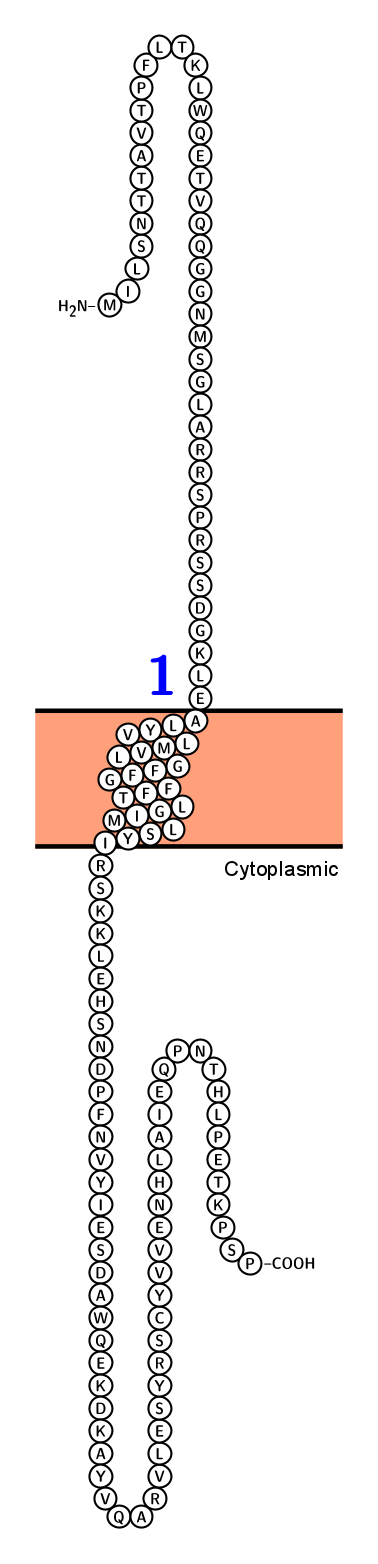
Entry: P15382
Mass: 14.675 Da
Transmembrane: 1
Subcellular location: Cell membrane {ECO:0000269|PubMed:19219384}, Single-pass type I membrane protein {ECO:0000305}. Apical cell membrane {ECO:0000250|UniProtKB:P15383}. Membrane raft {ECO:0000269|PubMed:20533308}. Note=Colocalizes with KCNB1 at the plasma membrane (By similarity). Targets to the membrane raft when associated with KCNQ1 (PubMed:20533308). {ECO:0000250|UniProtKB:P15383, ECO:0000269|PubMed:20533308}.
Cofactor: -
Extinction coefficient: 1.359
Isoelectric Point: 6.83
PubMed ID: 2730656, 7828904, 15489334, 9312006, 9230439, 11874988, 19219384, 20533308, 21676880, 21669976, 26307551, 18611041, 8899564, 9328483, 9354783, 9354802, 9445165, 10400998, 10973849, 11692163, 15051636, 16414944, 16823764, 19716085, 25037568
Family: Potassium channel KCNE family
Function:
Ancillary protein that assembles as a beta subunit with a voltage-gated potassium channel complex of pore-forming alpha subunits. Modulates the gating kinetics and enhances stability of the channel complex. Assembled with KCNB1 modulates the gating characteristics of the delayed rectifier voltage-dependent potassium channel KCNB1 (PubMed:19219384). Assembled with KCNQ1/KVLQT1 is proposed to form the slowly activating delayed rectifier cardiac potassium (IKs) channel. The outward current reaches its steady state only after 50 seconds. Assembled with KCNH2/HERG may modulate the rapidly activating component of the delayed rectifying potassium current in heart (IKr). {ECO:0000269|PubMed:19219384}.
Data from experiment(s):
Involvement in disease:
Jervell and Lange-Nielsen syndrome 2 (JLNS2) [MIM:612347]: An autosomal recessive disorder characterized by congenital deafness, prolongation of the QT interval, syncopal attacks due to ventricular arrhythmias, and a high risk of sudden death. {ECO:0000269|PubMed:10400998, ECO:0000269|PubMed:21676880, ECO:0000269|PubMed:9328483, ECO:0000269|PubMed:9354783}. Note=The disease is caused by variants affecting the gene represented in this entry.; Long QT syndrome 5 (LQT5) [MIM:613695]: A heart disorder characterized by a prolonged QT interval on the ECG and polymorphic ventricular arrhythmias. They cause syncope and sudden death in response to exercise or emotional stress, and can present with a sentinel event of sudden cardiac death in infancy. {ECO:0000269|PubMed:10400998, ECO:0000269|PubMed:10973849, ECO:0000269|PubMed:11692163, ECO:0000269|PubMed:16414944, ECO:0000269|PubMed:19716085, ECO:0000269|PubMed:25037568, ECO:0000269|PubMed:9354802, ECO:0000269|PubMed:9445165}. Note=The disease is caused by variants affecting the gene represented in this entry.
Binding site:
-
Tissue specificity:
Expressed in lung, kidney, testis, ovaries, small intestine, peripheral blood leukocytes. Expressed in the heart (PubMed:19219384). Not detected in pancreas, spleen, prostate and colon. Restrictively localized in the apical membrane portion of epithelial cells. {ECO:0000269|PubMed:19219384, ECO:0000269|PubMed:9312006}.
3D (X-ray crystallography):
NMR spectroscopy (1)
Pharmaceutical use:
-
AS sequence:
MILSNTTAVTPFLTKLWQETVQQGGNMSGLARRSPRSSDGKLEALYVLMVLGFFGFFTLGIMLSYIRSKKLEHSNDPFNVYIESDAWQEKDKAYVQARVLESYRSCYVVENHLAIEQPNTHLPETKPSP
Creditnotes:
The protein visualizations are generated with the help of Protter:
Omasits, U., Ahrens, C.H., Müller, S., Wollscheid, B. “Protter: interactive protein feature visualization and integration with experimental proteomic data”. Bioinformatics. 2014 Mar 15; 30(6):884-6. doi: 10.1093/bioinformatics/btt607.
IP and extinction coefficients are gathered from Protparam by ExPASy:
Gasteiger, E., Hoogland, C., Gattiker, A., Duvaud, S., Wilkins, M.R., Appel, R.D., Bairoch, A. “Protein Identification and Analysis Tools on the ExPASy Server”. (In) John M. Walker (ed): The Proteomics Protocols Handbook, Humana Press (2005). pp. 571-607
The basic knowledge is found on UniProt:
The UniProt Consortium. “UniProt: the universal protein knowledgebase in 2021”. Nucleic Acids Res. 49:D1 (2021)
Omasits, U., Ahrens, C.H., Müller, S., Wollscheid, B. “Protter: interactive protein feature visualization and integration with experimental proteomic data”. Bioinformatics. 2014 Mar 15; 30(6):884-6. doi: 10.1093/bioinformatics/btt607.
IP and extinction coefficients are gathered from Protparam by ExPASy:
Gasteiger, E., Hoogland, C., Gattiker, A., Duvaud, S., Wilkins, M.R., Appel, R.D., Bairoch, A. “Protein Identification and Analysis Tools on the ExPASy Server”. (In) John M. Walker (ed): The Proteomics Protocols Handbook, Humana Press (2005). pp. 571-607
The basic knowledge is found on UniProt:
The UniProt Consortium. “UniProt: the universal protein knowledgebase in 2021”. Nucleic Acids Res. 49:D1 (2021)