


Phosphoproteomics Workflow Optimization
Cube Biotech is a leading provider of innovative solutions for proteomics research, offering a wide range of products designed to enhance enrichment strategies and enable more reproducible results for targeted assays. The present report focuses on the application of Fe-NTA MagBeads from Cube Biotech in a phosphoproteomics workflow, as recommended by Thomas Perkins Jr., a scientist from the University of Washington's Department of Genome Sciences.
Background:
Phosphoproteomics is a crucial field within proteomics research, studying the dynamics of protein phosphorylation in cell signaling pathways. However, achieving reliable and efficient enrichment of phosphorylated peptides can be challenging. Cube Biotech's Fe-NTA MagBeads offer a promising solution, Perkins states, as they provide “enhanced sensitivity, specificity, and deeper insights into phosphorylation dynamics through improved identification and quantification of phosphorylated peptides”.
Benefits and Features:
- Enhanced Sensitivity and Specificity: The Fe-NTA MagBeads enable researchers to achieve superior sensitivity and specificity in identifying and quantifying phosphorylated peptides, allowing for more accurate analysis of cell signaling events.
- Automation-Friendly: The phosphoproteomics procedure is simplified by the ease of automation of Fe-NTA MagBeads. The ability to incorporate these beads into automated processes reduces waiting time and boosts productivity. A great example from the Villén lab at UW led by Dr. Mario Leutert can be found here: https://pubmed.ncbi.nlm.nih.gov/31885202/.
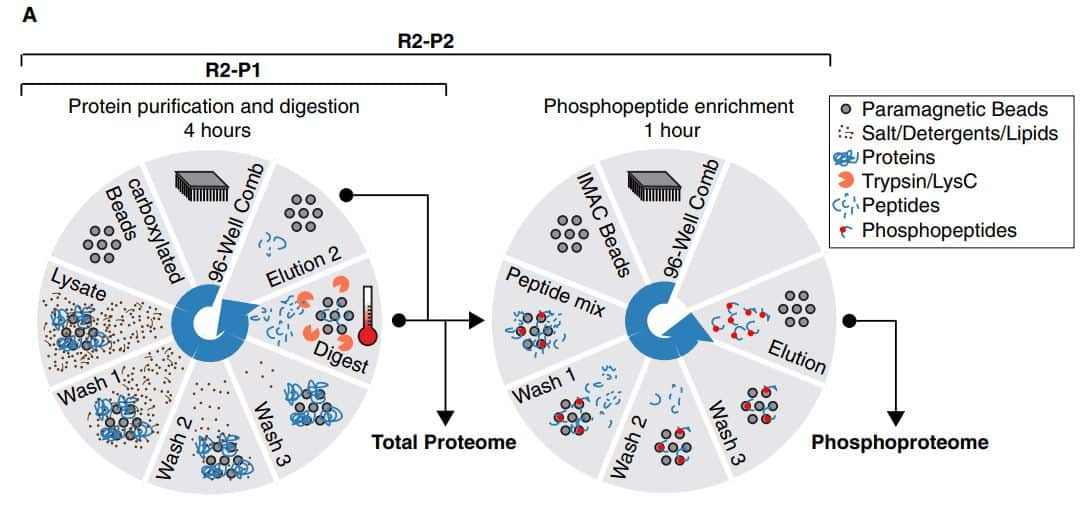
Fig.1: Schematic depiction of the setup of a R2-P2 assay using a KingFisherTM Flex. The robotic configuration allows for loading of eight different 96-well plates. Each plate can be rotated into position under a 96-pin magnetic head that drops down inside the 96-well plate to release, bind, or agitate the magnetic microspheres in solution. In the first robotic run, peptides are captured from lysates by carboxylated magnetic beads, purified, and eluted by digestion at 37°C. Eluted peptides are dried down and can be resuspended for total proteome analysis by LC-MS/MS and/or for automatic phosphopeptide enrichment. Phosphopeptides are enriched using a second robotic run on the KingFisherTM Flex, using Fe-IMAC, Ti-IMAC, Zr-IMAC, or TiO2 magnetic microspheres, and analyzed by LC-MS/MS to obtain the phosphoproteome. - Reusability: A notable advantage of Cube's Fe-NTA MagBeads is their reusability. By stripping the beads and reusing them several times, researchers can maximize cost-effectiveness while assuring quality control by evaluating the enrichment effectiveness after stripping.
Application in Human Cell Lines and Tissues:
While initially optimized for yeasts, Cube Biotech's Fe-NTA MagBeads have proven to be “equally effective in human cell lines and tissues”. This versatility makes them a valuable tool for studying cell signaling and conducting phosphoproteomics analyses in various biological contexts.
Scientific Endorsement:
University of Washington researcher Thomas Perkins has used Cube Biotech's products frequently and especially suggests their Fe-NTA MagBeads for phosphoproteomic workflows. He has successfully employed these beads to enrich phosphorylated peptides from various cell lines, including stimulated HCT116s, HEK293Ts, HeLas, MCF7s, Hap1s, K562s, and many more.
“I am a fan, so I definitely expect to use/test more of Cube Biotech GmbH products!”

University of Washington
Conclusion:
Cube Biotech's Fe-NTA MagBeads offer proteomics researchers an invaluable tool for optimizing phosphoproteomic workflows. With their enhanced sensitivity, automation-friendly design, reusability, and applicability to both yeasts and human cell lines, these beads enable more reproducible results and deeper insights into phosphorylation dynamics. Scientists, like Thomas Perkins, highly recommend Cube Biotech products, which also include nanodiscs, protein purification kits, and custom IMAC resins, making Cube Biotech GmbH a trusted partner for advanced proteomics research.
Keywords: Fe-NTA; MagBeads; Proteomics; Protein phosphorylation
