


MSP1E3D1 “Ultra Dark”, human

| Quantity | Unit price |
|---|---|
| 1 - 4 |
€361.00*
|
| From 5 |
€322.00*
|
Description
Other MSP products or related sites by Cube Biotech include:
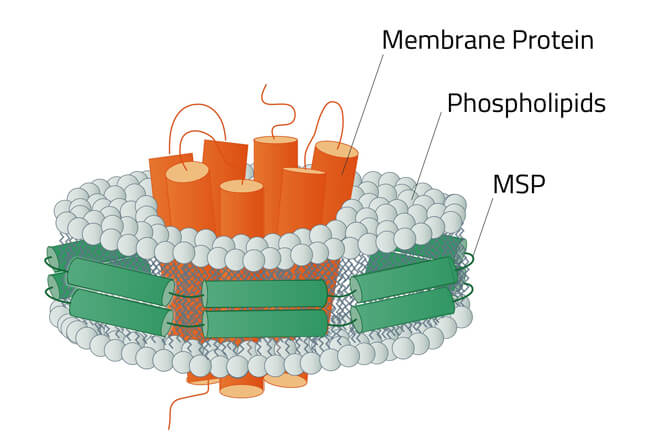
| Feature | |
|---|---|
| Form | Lyophilized |
| Amount | 2 mg |
| Available origins | Human |
| Purity | 90% (Determined by SDS-PAGE) |
| Number of amino acids | 256 |
| Molecular mass | 29.75 kDa |
| Extinction coefficient | Ext. coefficient -- |
| (in H2O) ε280 | Abs 0.1% (=1 g/l) -- |
| Buffer | 20 mM TRIS pH 7.4, 100 mM NaCl, 0.5 mM EDTA |
| Affinity tag | No tag |
| Sequence | G STFSKLREQLG PVTQEFFDNLEKETEGLRQEMS KDLEEVKAKVQ PFLDDFQKKFQEEMELFRQKVE PLRAELQEGARQKLHELQEKLS PLGEEMRDRARAHVDALRTHLA PFLDDFQKKFQEEMELFRQKVE PLRAELQEGARQKLHELQEKLS PLGEEMRDRARAHVDALRTHLA PFSDELRQRLAARLEALKENGG ARLAEFHAKATEHLSTLSEKAK PALEDLRQGLL PVLESFKVSFLSALEEFTKKLNTQ |
| Stability & Storage | Lyophilized protein: stable at -20°C for 24 months. Reconstituted protein: stable at 2-8°C for several days. |
| Shipping | Room temperature |
| Hazards | Product is not classified as hazardous according to (EC) No 1272/2008 [CLP]. A Material Safety Data Sheet is provided. |
| Application | |
| Recommended usage | The reduced UV absorption at 280 nm makes MSP1E3D1 "Ultra Dark" particularly advantageous over standard MSPs and alternative solubilization agents such as AASTY or SMA, enabling reliable UV-Vis based concentration determination and significantly reduced background interference in fluorescence-based assays and label-free detection methods. Beyond its spectroscopic advantages, MSP1E3D1 "Ultra Dark" is well suited for Cryo-EM, ELISA, and protein-protein interaction studies where unrestricted ligand access is required, and is further compatible with cell-free expression systems and a broad range of biomedical, proteomic, and protein biochemistry applications. |
| Manufacturer | Cube Biotech |
Citations
 Powered by Bioz
Video
We also recommend our video guide to nanodiscs in general.
FAQ
Can I get the datasheet for the MSP1E3D1 “Ultra Dark” protein?
Is this the correct MSP product for my membrane protein?
Why are there different origins for the MSP protein and do they work differently?
I have never worked with MSP nanodiscs before. Can you tell me more about them?
Are there other options to stabilize membrane proteins besides MSP nanodiscs?
Disclaimer
For research use only
Trademark information
The owners of trademarks marked by "®" or "TM" are identified at http://www.cube-biotech.com/information/patents. Registered names, trademarks, etc. used in this document, even when not specifically marked as such, are not to be considered unprotected by law.
Important licensing information
This product is covered by intellectual property (IP) rights and on completion of the sale Cube Biotech grants respective Limited Use Label Licenses to purchaser. IP rights and Limited Use Label Licenses for said technology are further described and identified at http://www.cube-biotech.com/information/patents or upon inquiry at info@cube-biotech.com or at Cube Biotech GmbH, Creative-Campus-Allee 12, D-40789 Monheim, Germany. By use of this product the purchaser accepts the terms and conditions of all applicable Limited Use Label Licenses.
